


For decades, the Japanese Domestic Market (JDM) was a niche playground for drifting enthusiasts and tuner subcultures. However, the landscape has shifted dramatically. Today, the most iconic vehicles from Japan’s “Golden Era”—roughly 1989 to 2002—have transcended “used car” status to become legitimate blue-chip alternative assets.
With the 25-year import rule constantly liberating more models for the American market, savvy collectors are looking beyond mere nostalgia. They are looking for vehicles with proven provenance, rarity, and historical significance. If you are looking to diversify your portfolio with high-performance machinery, these seven JDM icons represent the gold standard of automotive investments.
1. Nissan Skyline GT-R (R34)
The “Godzilla” moniker was earned by the R32, but the R34 refined the formula to near perfection. As the final generation to feature the legendary RB26DETT inline-six engine before the GT-R became its own standalone model, the R34 is the ultimate prize. Rare variants like the V-Spec II Nür or the M-Spec have already seen prices soar into the mid-six figures. Its digital-forward cockpit and ATTESA E-TS Pro AWD system made it a technological marvel of its time, ensuring its status as the “Poster Car” for an entire generation.
2. Toyota Supra MkIV (A80)
The A80 Supra is perhaps the most recognizable JDM car in the world. Its fame was cemented by cinema and the legendary over-engineering of the 2JZ-GTE engine. While many were modified to produce quadruple-digit horsepower, the real “blue chip” value lies in untouched, low-mileage examples. A bone-stock, Series 2 Turbo with a 6-speed manual transmission is increasingly rare, making it a cornerstone for any serious Japanese car collection.
3. Honda NSX-R (NA1 & NA2)
While the standard NSX was a “daily driver” supercar developed with input from Ayrton Senna, the “R” (Type R) variants are the true collectors’ gems. By stripping weight, stiffening the chassis, and blue-printing the engine to racing standards, Honda created a surgical instrument of speed. Because the NSX-R was never officially sold in the US, the scarcity of legal imports keeps demand at a fever pitch. It remains one of the few Japanese cars that can sit comfortably in a collection alongside Ferraris and Porsches.
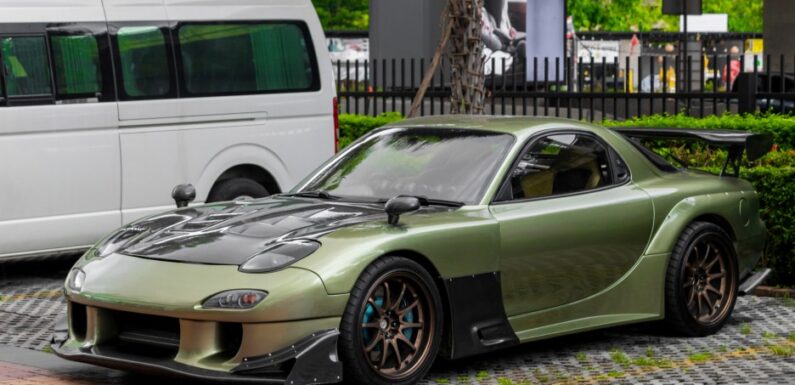
4. Mazda RX-7 FD3S Spirit R
The FD3S RX-7 is widely regarded as one of the most beautiful car designs to ever emerge from Japan. While all FDs are desirable, the Spirit R—the final run of just 1,500 units—is the peak of rotary development. It combined all the best features of previous limited editions into one package. As the world moves toward electrification, the high-revving, twin-turbocharged Wankel engine represents a unique mechanical era that will never be replicated, driving its long-term investment value.
5. Nissan Fairlady Z 432
For those who prefer vintage over “modern classics,” the Z 432 is the holy grail of the S30 chassis. The “432” stands for four valves per cylinder, three carburetors, and two camshafts—the exact specifications of the S20 engine found in the original Hakosuka GT-R. Only 420 units were produced. This car is a blue-chip asset because it represents the birth of Japanese performance on the global stage, often fetching prices at elite auctions that rival European exotics.
6. Mitsubishi Lancer Evolution VI Tommi Mäkinen Edition
Rally heritage is a massive driver of value in the collector world. The “Evo 6.5,” or Tommi Mäkinen Edition (TME), was built to celebrate the Finnish driver’s four consecutive WRC titles. With its distinct “Passion Red” livery, special interior embroidery, and faster-spooling titanium turbocharger, the TME is the most investment-grade Evolution ever built. It captures a specific moment in motorsport history that resonates deeply with global collectors.
7. Subaru Impreza 22B STi
If the Evo TME is the king of Mitsubishi, the 22B is the undisputed emperor of Subaru. Built in 1998 to celebrate Subaru’s 40th anniversary and their third consecutive WRC manufacturer’s title, only 400 were made for the Japanese market. With its wide-body flared fenders and 2.2-liter closed-deck engine, it is a street-legal rally car. Its rarity is so extreme that they seldom appear on the open market, and when they do, they command a massive premium.
Investing in these vehicles requires more than just a passion for driving; it requires a strategic financial approach. Because many of these cars are now valued well into the six-figure range, traditional auto loans often fall short. Seeking specialized financing for a JDM classic allows collectors to preserve their liquidity while securing an asset that historically appreciates at a rate far exceeding standard consumer vehicles.
When choosing a blue-chip JDM asset, documentation is everything. Original auction sheets, service records from Japan, and verification of “matching numbers” are what separate a high-end investment from a standard enthusiast car. For the serious collector, these seven models offer the perfect blend of historical importance, mechanical soul, and financial upside.
